
Intent
- To bring socially responsible and impact-driven design to the forefront of urban conversations.
- To create a physical platform of recognition for alumni, awardees, grantees, and contributors within the Arcause ecosystem.
- To provide visibility, legitimacy, and networking opportunities for innovators, practitioners, and grassroots organisations within the Ethos–Arcause universe.
To amplify urban causes through experiential learning, public engagement, and cross-sector dialogue.
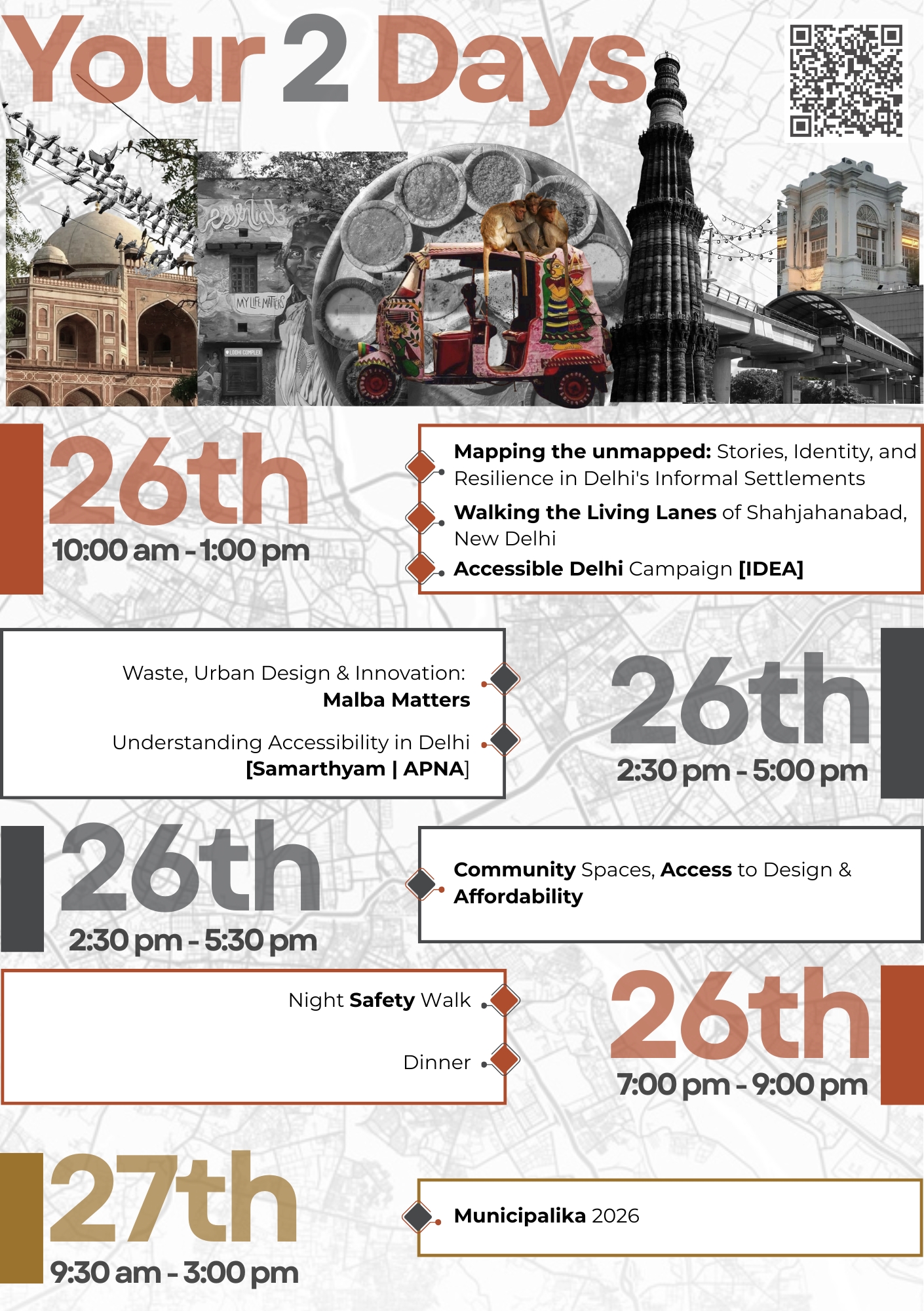
Monuments & Memory Walk
A curated walk exploring lost and neglected monuments, informal uses of heritage spaces, and layered historical narratives, alongside a school-level essay/sketching activity on “My Heritage” to encourage early engagement with cultural memory.
Facilitated By: Dronah
Time: 10:00 AM – 01:00 PM
Design Literacy: Stories, Identity, and Resilience in Delhi’s Informal Settlements
This experiential learning engagement invites participants to encounter the lived realities of communities existing on the margins of official recognition and legal frameworks. Through a curated walk and sensory mapping exercise at an informal settlement in Delhi (either along Jangpura drain or at Subhash Camp in Dakshinpuri), participants will engage directly with residents whose homes, lives, and identities exist in a paradoxical state of being both present and absent, visible yet unmapped, rooted yet labeled as transient.
Facilitated By: Ikhat Society
Time: 10:00 AM – 01:00 PM
Understanding Accessibility in Delhi
Phase 1: Immersive Orientation at CCPD (Approx. 30 minutes)
We propose to begin the session at the Office of the Chief Commissioner for Persons with Disabilities (CCPD), who have agreed in principle to host the delegates. The session will open with an orientation by Shri. Govindraj Sir, Commissioner, CCPD. This will include:
● Sensitisation on the RPwD Act
● Framing accessibility through a design thinking lens
● Understanding physical, sensory, and systemic barriers
We will then introduce participants to the Self-Assessment Accessibility Tool designed by
IDEA and explain how it can be applied in real urban contexts.
Phase 2: On-Ground Accessibility Audit Participants will be divided into groups. Together, they will conduct accessibility audits of selected sites. The intent is to move from theoretical understanding to lived experience, observation, and collaborative evaluation.
Phase 3: Reflection & Collective Learning After completing the audit, all groups will reconvene for a facilitated reflection session. This will include:
● Sharing observations
● Identifying gaps and systemic challenges
● Discussing design responses and policy implications
● Concluding with key takeaways and actionable insights
Facilitated By: Inclusive Divyangjan
Time: 10:00 AM – 01:00 PM
Waste, Urban Design & Innovation
An on-ground exploration of Delhi’s waste systems, examining how design, policy, and everyday behaviour intersect, and identifying opportunities for innovation in waste management and circular urban practices.
Facilitated By: Malba Project
Time: 02:30 PM – 05:00 PM
Community Spaces, Access to Design & Affordability
Activity would be a walk to the Yamuna river and then a discussion on Delhi’s riverfront development and need for inclusion of riverine livelihoods. This would be held at a community built school/anganwadi with the local farmers, builders and design team to talk about processes of co-creation for social infrastructure in informal settlements.
Facilitated By: Social Design Collaborative
Time: 02:30 PM – 05:00 PM
Understanding Accessibility in Delhi
An accessibility audit of the India Habitat Centre will assess how inclusive one of Delhi’s key public institutions is. Participants will evaluate entrances, circulation, signage, restrooms, and event spaces across physical, sensory, and informational dimensions using a structured framework. The exercise will identify strengths and gaps, encouraging critical reflection on inclusive design and generating practical recommendations to strengthen accessibility in public environments.
Facilitated By: Samarthyam | APNA
Time: 02:30 PM – 05:00 PM
Night Safety Walk
To experience the city from a woman’s perspective at night, understanding how urban design, lighting, surveillance, transport, and social behavior impact safety.
Facilitated By: Safetipin
Time: 07:30 PM – 08:00 PM